MIPS Actus Platforms
Bringing deterministic intelligence into physical systems
Purpose-built for accurate, real-time performance
Built for the Physical AI Future: Smooth, Accurate, Human-like Motion Performance
Deterministic control
Real-time MCU
Vector processing
Software-first development
Virtual platforms and digital twins for earlier software development
Accelerating Physical AI Development
Actus is built for systems where timing, responsiveness, and predictable control are as important as compute performance. Its architecture combines real-time processing, signal processing acceleration, control interfaces, software enablement, and safety-oriented capabilities into a unified development platform optimized for physical-world interaction. Actus combines the MIPS M8500 RISC-V CPU with high-resolution PWM, high-speed ADCs, and hardware-accelerated trigonometric functions to reduce end-to-end control-loop latency, enabling deterministic motor control, more precise motion, and safer operation in robotics and industrial systems.
The platform’s software-first foundation helps development teams start earlier and move faster. With virtual platform support, digital twin capabilities, and production oriented hardware targets, developers can evaluate control algorithms, software stacks, and application performance before committing to final hardware implementations.
Features
- Actus-1 is a platform for responsive Physical AI systems
- Enabling event-driven embedded applications:
- motion control; sensor fusion; predictive maintenance
- Enabling event-driven embedded applications:
- Embedded Intelligence
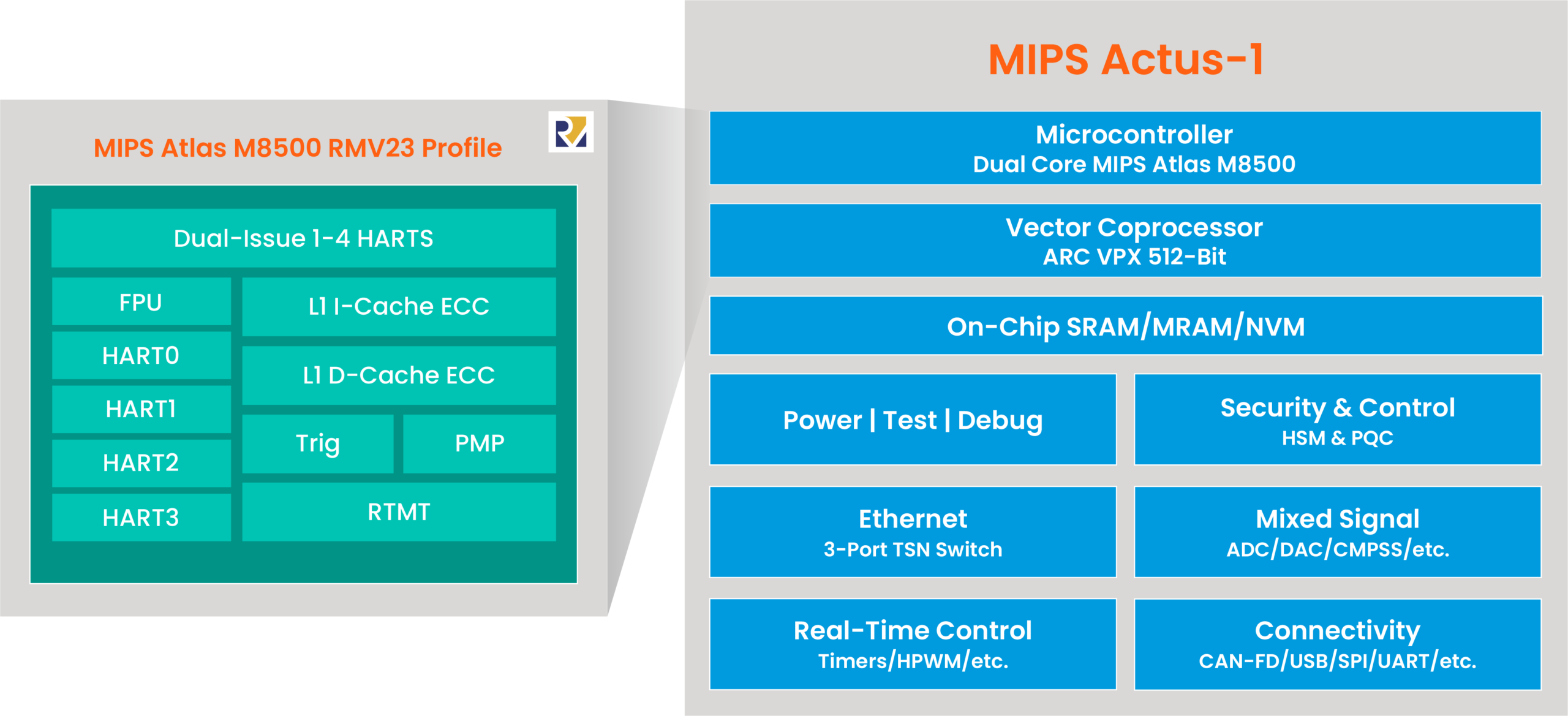
- MIPS Atlas M8500: RMV23 profile support
- Real-time multithreading architecture with FoC acceleration
- ARC VPX 512-bit vector co-processor
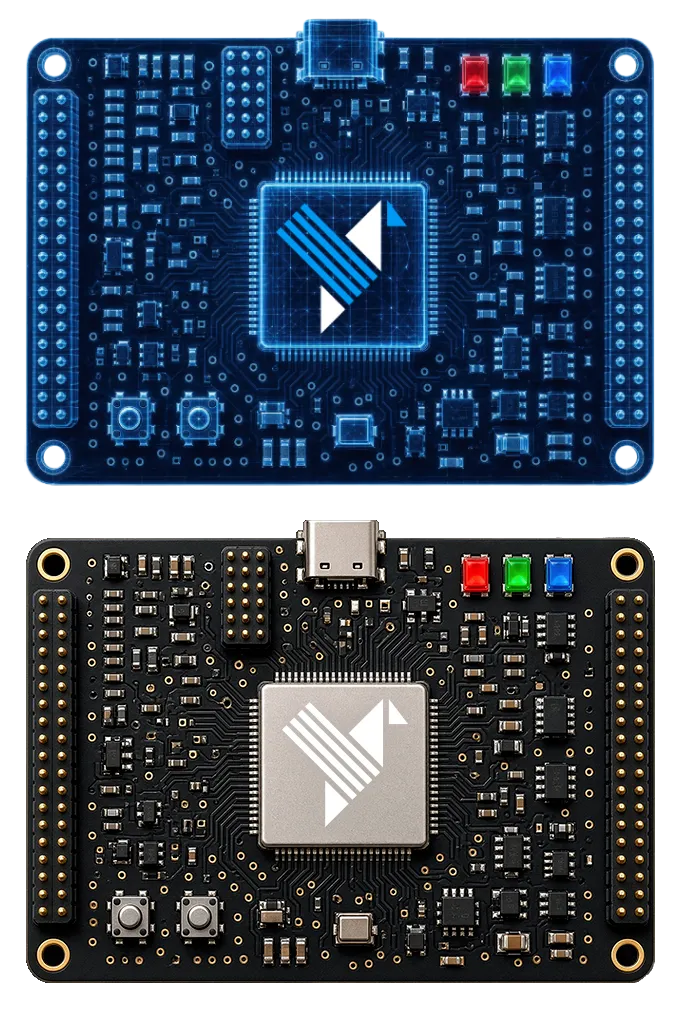
- Single-board computer form-factor for easy integration and lab use
- Standards Based Development
- ISO 26262 & ISO 21434
Block diagram: MIPS Actus-1
Any performance, safety, security, certification, or product capability statements are subject to final product specifications, software configuration, implementation, workload characteristics, and applicable certification scope. Results and capabilities may vary by deployment.