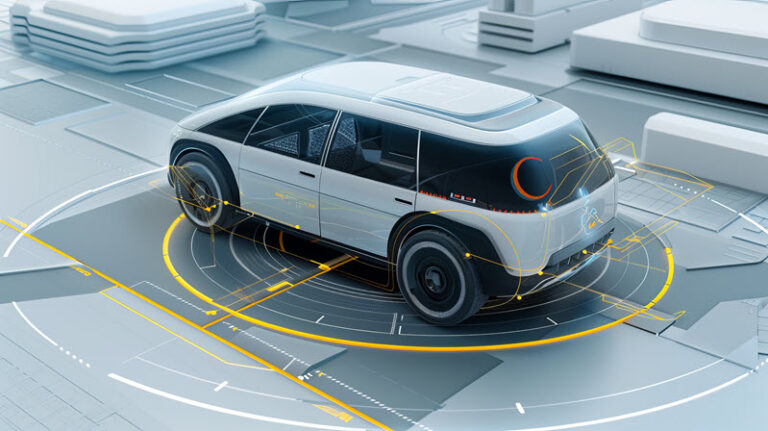

Physical AI is the ability for machines to sense their environment, think locally, act safely, and communicate quickly without waiting on the cloud. In safety-critical scenarios like driver assistance or industrial robotics, milliseconds matter. That’s why MIPS’ edge-first approach focuses on ultra-low latency, low power, and cost-efficient inference delivered by its Atlas portfolio—and specifically the S8200 “Think” subsystem.
What is MIPS S8200 software-first neural processing unit?
MIPS S8200 is a scalable, RISC-V–based NPU designed for autonomous edge platforms. It combines tightly coupled AI engines with RISC-V application cores to accelerate both vector and matrix workloads, supporting modern frameworks (PyTorch, TensorFlow) and scaling from tens to hundreds of TOPS via coherent cluster tiling, while targeting higher TOPS/W efficiency than legacy architectures for edge deployments. In the MIPS Atlas portfolio, MIPS S8200 is the decision engine that enables multi-modal inference on device. MIPS positions S8200 under the “Think” pillar of the “Sense, Think, Act, Communicate” workload so customers can build complete physical-AI stacks with predictable latency and safety.
Why on-device AI at the edge?
Sending sensor data to the cloud and waiting for inference increases latency, risks privacy, and consumes power, which is unacceptable when a vehicle must brake now, or a robot must intercept a falling object with human-like (or better) reflexes. On-device AI lets platforms react in milliseconds under tight thermal and battery constraints. From a systems perspective, dedicated NPUs deliver inference far more power-efficiently than GPUs while freeing general purpose processors for other tasks, ideal for battery or thermally-limited endpoints.
Key Use Cases Enabled by MIPS S8200
1) Automotive ADAS & Autonomous Perception (Front Camera + 360°)
Modern vehicles aggregate feeds from multiple cameras to build a bird’s-eye view (BEV) around the car. Leading models like BEVFormer1 fuse spatial and temporal cues with transformer architectures, enabling robust perception for lane structures, vehicles, and pedestrians—even in low visibility. S8200’s transformer-friendly design and vector/matrix acceleration help run BEVFormer-class workloads and concurrent tasks (e.g., drive policy) in parallel, meeting stringent latency budgets.
- Front-camera ADAS: rapid detection/classification for forward collision warning, lane keeping, and traffic-signal understanding.
- Full-surround perception: camera fusion to detect adjacent vehicles/pedestrians with faster-than-human reaction times.
- Concurrent decision-making: drive policy modules run alongside perception to determine acceleration, braking, and lane changes.
2) Industrial Robotics & AMRs
Factories, warehouses, and mobile robots are evolving beyond fixed paths to human-interactive, task-adaptive behavior. These systems use vision-language-action (VLA) models: listening to natural language, understanding intent, locating the target, and safely manipulating it with appropriate force or speed, and path planning in real time. MIPS S8200 brings multi-modal inference to the edge so robots can operate autonomously without cloud round-trips, preserving privacy and uptime.
3) Healthcare, Agriculture, and Smart Manufacturing
MIPS S8200’s multi-modal capabilities enable diverse edge scenarios: predictive maintenance & quality control in smart factories; medical imaging assistance and monitoring at the point of care; precision farming (pest detection, crop monitoring) and autonomous implements. These are among the target verticals MIPS highlights for physical AI at the edge.
Open & Modular: Built for “Any Model, Past, Present; and Future”
Teams need freedom to optimize their models, and MIPS’ open approach leans on RISC-V (an open, extensible, instruction set architecture) so implementers can add custom instructions to benefit the workload (e.g., accelerating softmax in transformer attention) and co-design the software and hardware together. On the software side, MIPS embraces MLIR and the IREE ecosystem to modularize the compiler/runtime via dialects, making it easier to plug in optimizations, target diverse accelerators, and keep the toolchain transparent. MIPS Atlas Explorer lets teams model workloads, predict performance, and identify bottlenecks before hardware is fixed, allowing designers to prioritize use-case performance over raw TOPS.
Why S8200 for Product & Engineering Teams
- Edge-first performance: deterministic latency for safety-critical actions in vehicles and robots.
- Scalable efficiency: coherent cluster tiling from 10 TOPS to 100s of TOPS
- Future-proof: designed to run convolutional and transformer workloads, including BEVFormer-class perception and VLA models without locking into proprietary stacks.
- Open ecosystem: RISC-V + MLIR/IREE for customizable, transparent optimization pipelines.
- Faster decisions: Atlas Explorer to de-risk design choices before tape-out and/or platform freeze.
The Bottom Line
As AI moves from cloud demos to real machines that navigate streets and factory floors, the winners will be platforms that sense-think-act at the edge. MIPS S8200 gives teams a practical path to deploy multi-modal, transformer-class AI locally—with the open tooling and simulation-first workflow engineers need to hit their latency, power, and safety targets. This shift also addresses a looming labor gap: U.S. manufacturing could face ~2.0–2.1M unfilled jobs2 by ~2030, increasing the need for automation that is safe, flexible, and easy to deploy – the autonomous edge with Physical AI built on MIPS.
Footnotes
1 – BEVFormer (ECCV 2022) arXiv: https://arxiv.org/abs/2203.17270
2 – Manufacturing labor gap (NAM/Deloitte): https://nam.org/2-1-million-manufacturing-jobs-could-go-unfilled-by-2030-13743/